Running an ecommerce store in 2026 without a solid SEO strategy is like opening a shop in a city with no signage. Customers exist, demand exists, but they simply cannot find you. The tools you use to build and execute that strategy matter enormously, and the debate between free and paid SEO tools is one that every ecommerce store owner eventually faces. The good news is that this is not a binary choice. The better answer depends heavily on where your store stands, what your goals are, and how seriously you treat search visibility as a growth channel.
This guide cuts through the noise and gives you a realistic comparison of what free tools can and cannot do, where paid platforms genuinely pull ahead, and how to make the right decision for your specific situation in 2026.
The Current State of Ecommerce SEO in 2026
Search engine optimisation for ecommerce has grown substantially more competitive. Google’s algorithm updates over the past two years have increasingly prioritised product page quality, site speed, structured data, and genuine user experience signals. Simply stuffing keywords into product descriptions no longer moves the needle. Ecommerce brands that rank well today are investing in comprehensive keyword strategies, technical audits, backlink analysis, and content that genuinely serves buyer intent at every stage of the funnel.
This means that the tools you use are no longer a minor operational detail. They directly influence the quality of decisions you make about what to optimise, what to create, and where to focus your time. Knowing what SEM means in digital marketing and how it intersects with organic SEO has become foundational knowledge for any store owner serious about sustainable growth.
What Free SEO Tools Actually Offer
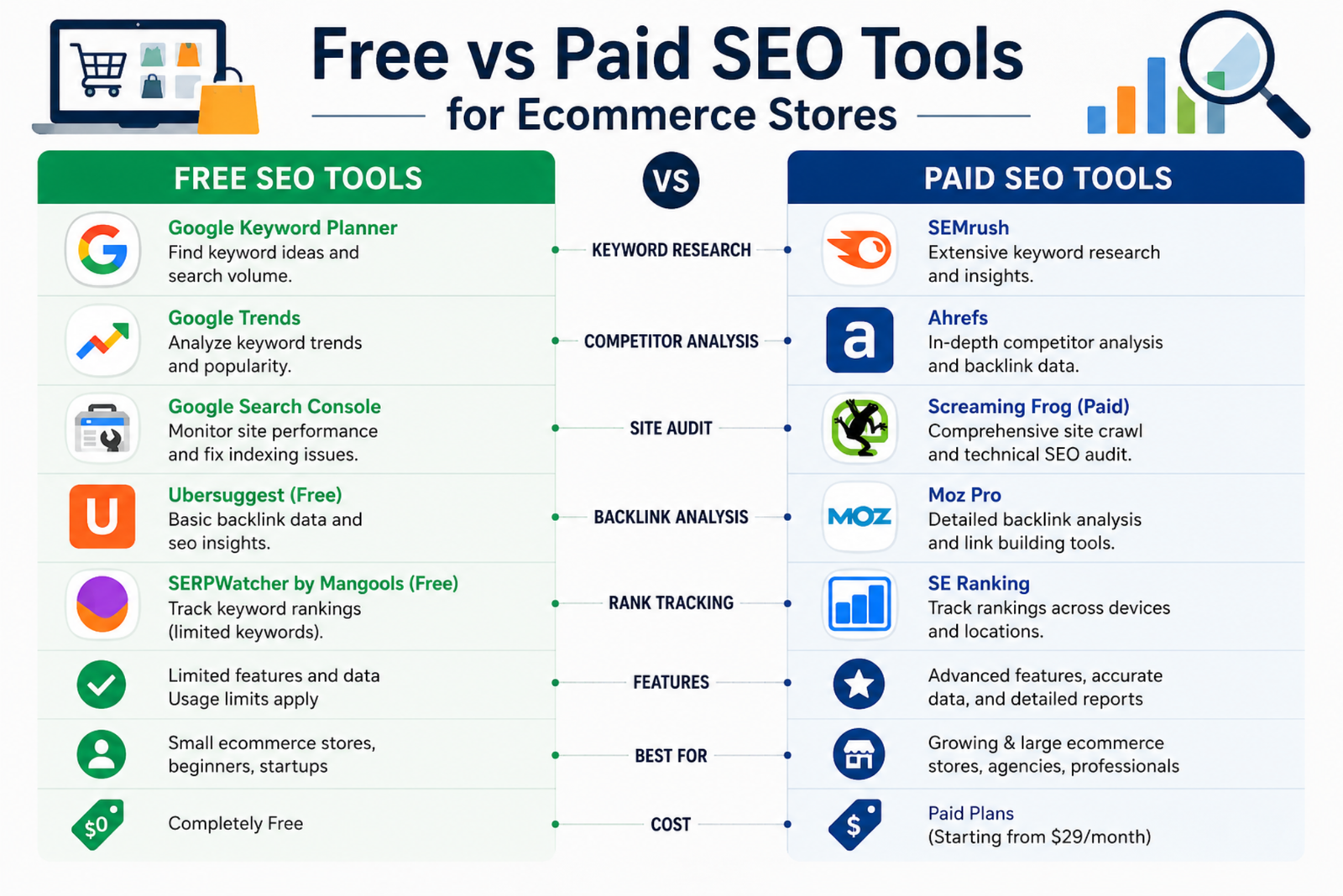
Free SEO tools have improved dramatically over the years. For a bootstrapped store or a business just getting started, the free ecosystem can take you surprisingly far. Here is what you can genuinely accomplish without spending a single dirham or dollar on SEO software:
Google Search Console — Tracks your rankings, identifies crawl errors, shows which queries bring traffic, and monitors Core Web Vitals performance. This is indispensable regardless of your budget.

Google Analytics 4 — Provides full traffic data, conversion tracking, user behaviour insights, and ecommerce reporting at no cost.
Google Keyword Planner — Useful for discovering search volume trends and keyword ideas, though primarily designed for paid advertisers.
Ubersuggest (Free Tier) — Offers limited keyword data, basic competitor analysis, and site audit features.
Screaming Frog SEO Spider (Free Version) — Crawls up to 500 URLs, which works well for smaller product catalogues.
AnswerThePublic (Free Searches) — Surfaces question-based queries that map to customer intent beautifully.
Google Trends — Excellent for understanding seasonal demand, trending products, and regional interest patterns.
For a store with fewer than 200 product pages, modest competition, and a patient growth mindset, these tools combined can deliver a functional SEO workflow. The limitation is not the tools themselves but the depth of insight they provide and the time you must invest to make them work together manually.
Where Free Tools Fall Short for Ecommerce
The gaps in free SEO tools become apparent quickly once your store grows or your competition intensifies. Free tools generally struggle with the following areas that matter most to ecommerce operations:
Competitive backlink analysis — Understanding who links to your competitors, what anchor text they use, and which pages attract the most authority requires paid data.
Rank tracking at scale — Monitoring rankings for hundreds of product and category pages across multiple locations is not feasible with free tools.
In-depth site audits — Free crawlers cap URL limits, miss JavaScript-rendered content, and lack the reporting depth needed to prioritise technical fixes efficiently.
Keyword difficulty scoring — Without reliable difficulty metrics, you waste effort targeting keywords that are nearly impossible to rank for at your current authority level.
Content gap analysis — Identifying which topics your competitors rank for that you do not is one of the most powerful ecommerce content strategies, and it requires paid-level data to do properly.
What Paid SEO Tools Bring to the Table
Paid SEO platforms like Ahrefs, Semrush, Moz Pro, and others exist because the data they provide is genuinely different in scale and accuracy. For ecommerce stores competing in crowded niches, this data translates directly into smarter decisions and faster results. When evaluating seo software tools for your store, consider what each platform offers beyond keyword volume numbers.
The most meaningful advantages of paid SEO tools for ecommerce include:
Accurate backlink databases — Paid tools index tens of billions of backlinks and update regularly, giving you a real picture of the competitive link landscape.
Historical ranking data — Seeing how your rankings have shifted over time, and when competitors gained or lost positions, informs your strategy in ways real-time snapshots cannot.
Keyword clustering — Some platforms now automatically group related keywords into topic clusters, which directly supports the way modern ecommerce SEO structures product and category pages.
Position tracking with SERP features — Paid tools tell you not just where you rank, but whether a featured snippet, shopping carousel, or image pack is appearing for your target keywords.
Competitor traffic estimates — Knowing roughly how much organic traffic your top competitors receive helps you benchmark realistically and spot strategic opportunities.
Side-by-Side Comparison: Free vs Paid SEO Tools
| Feature | Free Tools | Paid Tools |
|---|---|---|
| Keyword Research | Basic volume and suggestions | Full difficulty scores, intent data, clustering |
| Backlink Analysis | Very limited or unavailable | Deep competitor and own-site analysis |
| Site Audit Depth | Up to 500 URLs (Screaming Frog free) | Unlimited crawl with issue prioritisation |
| Rank Tracking | Manual via Search Console | Automated daily tracking at scale |
| Competitor Analysis | Surface level only | Traffic, keywords, gaps, and ad data |
| Content Gap Analysis | Not available | Full gap reports vs multiple competitors |
| Reporting | Manual compilation required | Automated dashboards and scheduled reports |
| Monthly Cost | Free | Typically $99 to $500+ depending on plan |
Which Option Makes More Sense for Your Store?
The honest answer is that your current revenue, competition level, and growth ambition should drive this decision. There is no one-size-fits-all answer, but there is a practical framework that maps the decision clearly.
Stick with free tools if:
- Your store generates less than $2,000 per month in revenue
- You are in a low-competition niche with limited local competitors
- You have a small product catalogue under 100 to 200 SKUs
- You are still in the learning phase of SEO and building foundational knowledge
- Cash flow is tight and every expense must be justified with near-term returns
Invest in paid tools if:
- Your store generates enough revenue to absorb a $100 to $200 monthly tool investment
- You are competing in a niche with established players dominating search results
- You manage a large catalogue with hundreds of product and category pages
- You run paid ads alongside organic SEO and need integrated data
- You want to scale content production and need keyword and topic data at volume
For stores operating in the UAE and wider Gulf markets, understanding the local search landscape adds another layer. Businesses listed on directories and community platforms benefit from local SEO signals that extend beyond product pages. For example, many companies seeking visibility in the UAE leverage market research services in the UAE to better understand their competitive environment before building an SEO strategy.
A Practical Starting Approach for Ecommerce Stores in 2026
Rather than viewing this as an all-or-nothing decision, most successful ecommerce operators use a hybrid approach. Start with Google Search Console and Analytics as your permanent foundation, regardless of budget. These tools are non-negotiable because they connect directly to how Google sees and indexes your store.
Layer in a paid tool on a trial basis, run a thorough competitor and keyword audit in the first month, and then evaluate whether the insights are generating enough strategic value to justify the recurring cost. Most paid SEO platforms offer 7 to 14 day free trials, which gives you enough time to run meaningful reports before committing.
For content strategy, small and mid-sized ecommerce stores often find that investing in one good paid keyword research session quarterly, rather than maintaining a full subscription year-round, delivers strong ROI. Export your keyword data, build your content calendar, and execute consistently before the next quarterly refresh.
Stores that are also exploring digital advertising alongside organic search should consider that understanding SEM in digital marketing allows you to use paid search data to inform your organic keyword strategy. The data flows both ways, and integrated ecommerce brands leverage this connection deliberately.
Frequently Asked Questions
Can free SEO tools really rank an ecommerce store in 2026?
Yes, in low to medium competition niches with a focused strategy, free tools like Google Search Console, Analytics, and Ubersuggest can support meaningful ranking improvements. However, scaling those results to a large catalogue or competitive market will eventually require paid data.
What is the best paid SEO tool for ecommerce specifically?
Semrush and Ahrefs are widely considered the strongest all-around platforms for ecommerce SEO. Semrush has stronger content and keyword tools, while Ahrefs excels in backlink analysis. The right choice depends on which gap is most critical for your store.
How much should an ecommerce store budget for SEO tools?
A practical entry-level budget for a growing ecommerce store is $99 to $149 per month for a single platform subscription. Larger stores managing multiple domains or requiring team access typically budget $200 to $500 per month across tools.
Are free keyword tools accurate enough for ecommerce decisions?
Free keyword tools provide directional data but often overstate or understate search volumes. For high-stakes decisions like which product categories to expand or which pages to prioritise, paid tools with more reliable volume and difficulty data reduce strategic risk significantly.
Should I use SEO tools or hire an SEO agency for my ecommerce store?
Both serve different purposes. Tools give you data and capability; an agency brings execution and expertise. For stores with the capacity to learn and implement, tools are the more cost-efficient starting point. Agencies make sense when execution bandwidth is the constraint, not knowledge or data access.
The free versus paid SEO tools debate in 2026 does not have a universal winner. Free tools remain powerful for ecommerce stores that are early stage, resource-constrained, or operating in niches where deep competitive data is not yet essential. Paid tools justify their cost quickly for stores competing seriously in crowded markets, managing large catalogues, or making strategic investments in content and authority building.
What matters most is not which category of tool you use, but how consistently and intelligently you apply the insights those tools provide. Start with what you can afford, use it well, and upgrade when the data you need to make better decisions is beyond what free tools can deliver. That is the approach that makes sense for serious ecommerce operators in 2026.
Related Reading: What Are SEO Tools for Ecommerce Stores and Which Features Matter Most in 2026?
Related Reading: Best All-in-One SEO Tools for Ecommerce Stores in 2026: What to Use and Why
Related Reading: Affordable SEO Tools for Ecommerce Stores on a Practical Budget in 2026 — full guide